
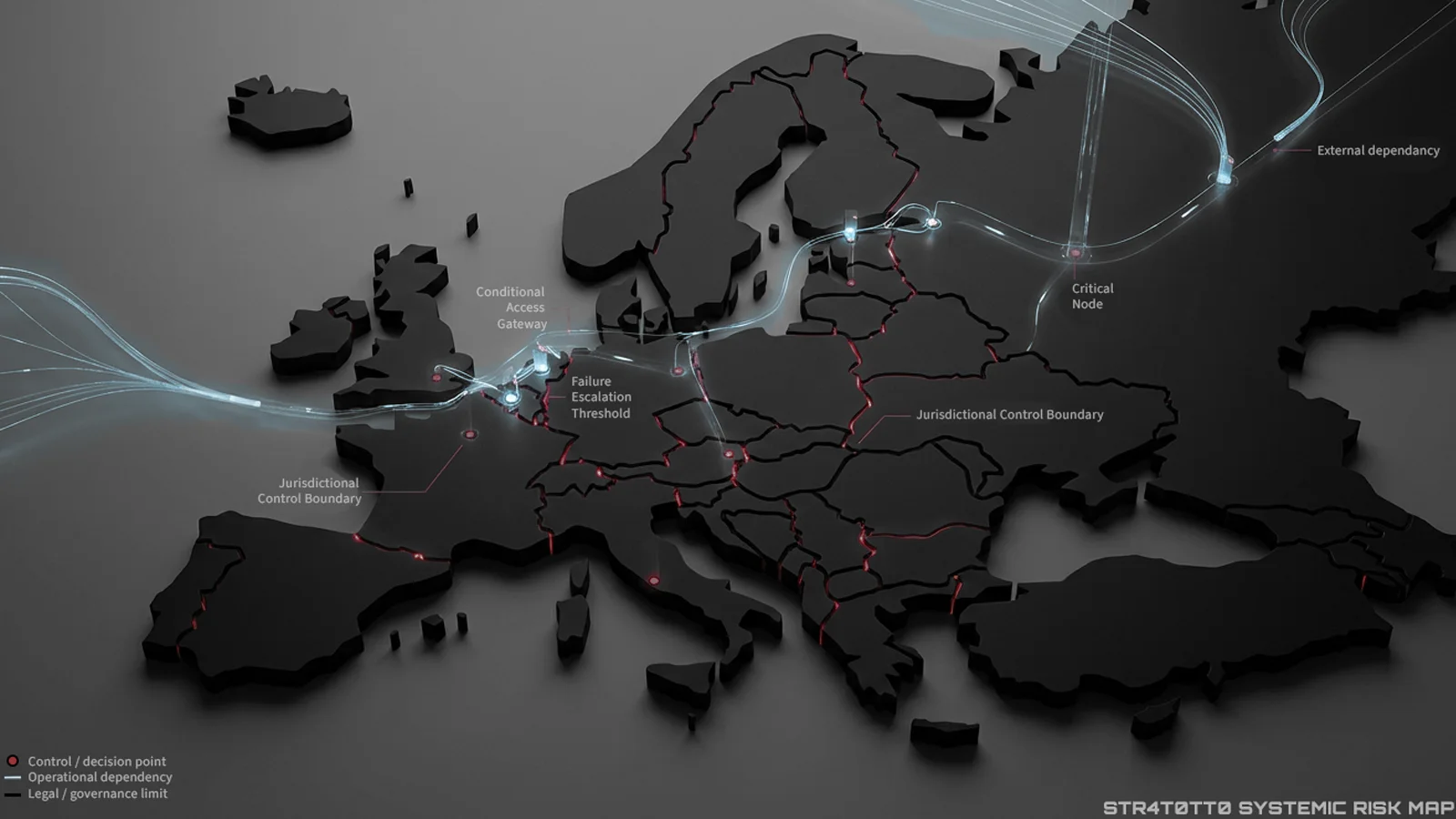
Europe’s digital dependency is not primarily about where servers are located.
It is about where control shifts when systems fail.
Under normal conditions, foreign cloud infrastructure appears neutral. Contracts are honored. Services run. Performance is measurable. Costs are optimized. Dependency appears to be a procurement decision.
Under abnormal conditions, that assumption breaks.
Legal escalation, sanctions, national security claims, emergency powers, disclosure orders, and political pressure can all shift decision authority away from the customer. The infrastructure may remain technically available while control over access, recovery, disclosure, and escalation moves elsewhere.
That is the real sovereignty question.
Not localization.
Not branding.
Not symbolic autonomy.
Digital sovereignty is fundamentally a risk pricing issue.
Recent market data shows the scale of the dependency. Synergy Research Group reported that Amazon, Microsoft, and Google account for roughly 70% of the European cloud market, while European providers remain around 15%. InCyber, citing a study commissioned by Cigref and Numeum, reported that American firms capture about 80% of European professional cloud spending, representing approximately €265 billion annually.
Those numbers are often presented as industrial policy data. They should also be read as risk-pricing data.
They reveal where Europe pays for capability, where it depends on borrowed discretion, and where it has outsourced control over critical failure modes.
The structural reality of cloud dominance
Control always follows jurisdiction.
Europe’s cloud market is dominated by non-European hyperscalers operating under legal frameworks outside the EU’s institutional perimeter.
That does not make these providers unreliable. On the contrary, they are often operationally superior. Their scale, engineering depth, capital intensity, security tooling, global availability, and ecosystem integration are precisely why they dominate.
The strategic issue is not whether they work.
The strategic issue is who decides when legal or political stress changes the operating environment.
Cloud infrastructure is not a neutral utility. It embeds legal authority, escalation rights, enforcement obligations, discretionary controls, support channels, identity systems, audit trails, and recovery dependencies.
A European financial institution may run a highly resilient workload on a US-controlled cloud platform. The architecture may be technically sound. The service-level agreements may be strong. The data may be stored in Europe.
Yet under certain legal conditions, decision authority may still shift outside the customer’s jurisdiction.
That is the jurisdictional override problem.
The CLOUD Act is the most visible example, but the broader issue is structural. Once a provider is subject to external legal obligations, contractual commitments do not eliminate sovereign exposure. They only define the normal operating state.
Sovereignty is not tested in the normal operating state.
It is tested when legal authority and operational dependency collide.
When sovereignty is under stress
Digital reliance is not inherently irrational.
Under normal conditions, cloud dependency improves productivity, accelerates deployment, reduces capital intensity, and gives organizations access to capabilities they could not efficiently build alone.
The problem begins when dependency is priced as efficiency but behaves as control transfer.
A system can remain technically available while governance discretion changes hands.
Physical uptime means infrastructure and networks continue to function.
Logical uptime means applications and data remain usable.
Legal uptime means the organization still retains authority over access, disclosure, escalation, and recovery.
Most cloud resilience discussions focus on the first two layers.
The sovereignty problem lives in the third.
Support scope can be altered. Escalation can be delayed. Access can be restricted. Disclosure can be compelled. A provider may remain operationally stable while the customer loses practical discretion over outcomes.
That is not an outage.
It is a governance shift.
Contracts do not survive their first legal escalation.
This distinction matters because many organizations build continuity plans around technical failure rather than authority failure.
They prepare for degraded systems, regional outages, provider incidents, or data loss.
They do not always prepare for a scenario where the service still runs, but the organization no longer controls the conditions of recovery, disclosure, escalation, or legal response.
That is where sovereignty becomes measurable.
Not as a slogan.
As a loss function.
Resilience is not ownership
Once control has shifted, the question is no longer whether you own something.
The question is whether you can act.
Many sovereignty strategies confuse ownership with capability. National providers, local data centers, backup contracts, or multi-cloud architectures may improve continuity. They do not automatically create recovery autonomy.
Ownership does not guarantee restoration.
Domestic infrastructure does not guarantee independence if identity, access management, monitoring, incident coordination, cryptographic keys, backup orchestration, update pipelines, or escalation procedures remain externally controlled.
Conversely, foreign infrastructure can remain strategically acceptable for some workloads if recovery pathways are genuinely independent.
The core question is brutally simple:
Can the organization restore critical functions without the dominant provider’s permission, cooperation, identity plane, support channel, tooling, or discretionary approval?
If the answer is no, resilience is conditional.
Resilience is proven only after control is lost.
This is where hidden dependencies become visible.
Production workloads may be replicated. Data may be backed up. Infrastructure-as-code may exist. A second provider may be contracted.
But if identity depends on the primary provider, administrators may be locked out.
If monitoring depends on the same ecosystem, incident visibility may collapse.
If backups are orchestrated through the same control plane, restoration may fail.
If cryptographic keys are externally managed, data sovereignty becomes cosmetic.
If incident response tooling depends on the platform under stress, coordination becomes fragile.
The result is not necessarily total collapse. It is often partial restoration, degraded authority, delayed recovery, and strategic dependence at the worst possible moment.
That is why resilience should be measured by restoration independence, not by architecture diagrams.
Why regulation alone cannot produce capacity
Europe has strong regulatory power.
GDPR shaped global privacy norms. The Digital Markets Act and Digital Services Act increased pressure on dominant platforms. AI regulation is influencing global governance debates.
But regulatory power is not infrastructure power.
Regulation can constrain behavior, increase the cost of abuse, and shape incentives. It cannot by itself create hyperscale capability, deep engineering ecosystems, sovereign tooling, developer gravity, security depth, or industrial capacity.
That distinction is often blurred.
Europe can regulate the terms of dependency without eliminating dependency itself.
The scale gap is structural. Hyperscale cloud is a capital-intensive, winner-takes-most environment. It rewards early scale, ecosystem depth, developer adoption, global demand, and continuous investment. Market concentration is not an accident. It is an infrastructure-economic outcome.
This is why standards alone cannot deliver sovereignty.
Frameworks, certifications, and trust labels can improve transparency. They can reduce ambiguity. They can raise the cost of misrepresentation.
But standards without capacity may simply formalize dependence.
The strategic error would be to confuse normative influence with operational control.
A regulation can define what should happen.
Capacity determines what can happen.
Sovereignty remains attainable if defined by control
Digital sovereignty is often framed as a principle.
In practice, it is a budgetary decision constrained by infrastructure economics.
Rebuilding the full hyperscale cloud stack domestically would require enormous investment across data centers, compute, storage, networking, identity, security tooling, developer platforms, operations, and innovation capacity.
For most European actors, full-stack autonomy is not economically coherent.
That does not mean sovereignty is impossible.
It means sovereignty must be defined selectively.
Sovereignty is expensive. Dependency is priced.
The binary framing is misleading.
The choice is not full independence or total dependence. Modern systems are layered. Control varies by layer. Some dependencies are tolerable. Others are strategically unacceptable.
Stateless compute, commodity storage, non-critical applications, and scalable workloads may be outsourced rationally if their failure does not compromise governance.
Other layers are different.
Identity and access management, cryptographic key control, governance tooling, incident coordination, audit integrity, backup independence, and foundational open-source components determine who can act under stress.
These are control layers.
They deserve a different risk price.
A system is sovereign if its most critical failure modes can be managed internally without external approval, intervention, or discretionary cooperation.
Sovereignty ends where recovery requires validation from an external authority.
This definition is intentionally narrow. It avoids symbolic debates and forces a harder question:
Which failure modes are too important to outsource?
That is where capital should go.
Not into performative duplication.
Not into patriotic branding.
Not into local infrastructure that does not change control.
Into the layers where loss of discretion would create irreversible strategic damage.
The real price of digital sovereignty
Europe has not lost the internet.
It has lost predictable control over some critical digital failure modes.
That is a different diagnosis, and a more useful one.
Foreign infrastructure is not automatically hostile. Domestic infrastructure is not automatically sovereign. Localized data is not automatically controlled. Cloud efficiency is not automatically strategic weakness.
The issue is where discretion sits when systems are under pressure.
Who can approve recovery?
Who can delay escalation?
Who can compel disclosure?
Who controls identity?
Who controls cryptographic keys?
Who controls audit integrity?
Who can restore operations without permission?
Those questions convert sovereignty from political language into operational risk.
The strategic answer is not to eliminate all dependency. That is unrealistic and economically incoherent.
The answer is to price dependency honestly.
Some dependencies are efficient.
Some are tolerable.
Some are existential.
The role of leadership is to know the difference before stress conditions reveal it.
Digital sovereignty is not about symbolism or localization. It is about retaining the ability to exercise discretion when legal, political, and operational pressure converge.
If control over identity, cryptographic keys, escalation, auditability, and recovery is external, sovereignty does not exist, regardless of infrastructure location.
The market has already priced dependency.
The remaining question is whether Europe, and the organizations operating within it, are willing to price the cost of control.